
On Tuesday, the US held an historic mid-term election. In response to efforts by Republicans to limit voting rights and manipulate political power through gerrymandering of Congressional Districts, Americans turned out to vote and the overwhelming majority voted for Democrats.
While turnout this year did not break records (preliminary analysis indicates it was almost as high as turnout for the mid-term elections in 2018), turnout was particularly high in communities that had been most affected by the policies of the Trump Administration. The Brennan Center notes that turnout in majority-minority counties that had been affected by changes in the Voting Rights Act showed a 10-point jump since the last mid-term election in 2022 (here are my thoughts on how the Callais decision might reinvigorate the pro-democracy movement). In Texas, votes overall shifted to the Democrats, but the highest rates by far were seen in counties on the border with Mexico, which shifted towards the Democrats by 34.7%.
Every year, my team runs a national survey the two weeks before the election with YouGov (N = 1,500). The data we collected this year provide more information about what drove the huge Blue Wave that swept the country this week.
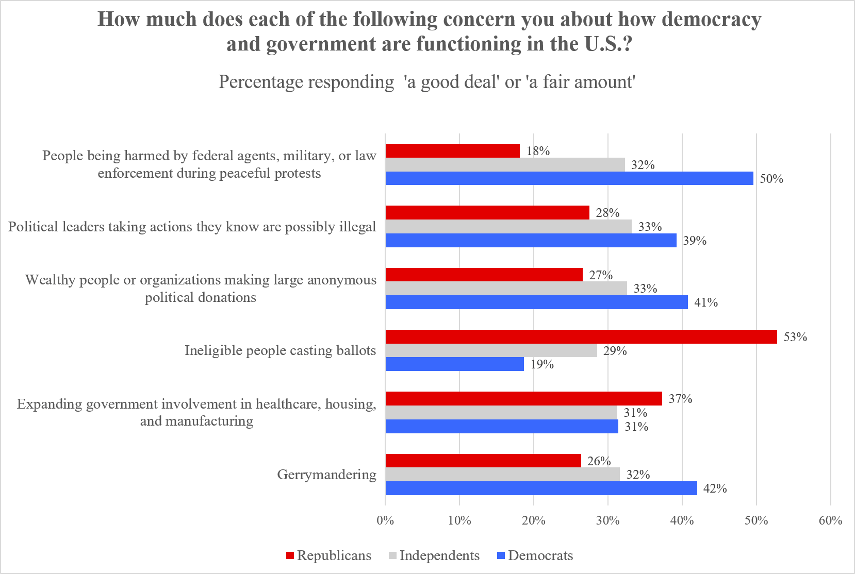
Democracy was clearly on the ballot. This year, we added questions that were originally fielded by the Democracy for All Project regarding possible concerns about the elections and democracy in America. The image above presents our findings broken down by party affiliation. Overall, Americans had many concerns about democracy in America going into the election, but there were significant differences based on party affiliation. Democrats expressed the highest levels of concern generally. Their anxieties were highest about people being harmed by federal agents, military, or law enforcement during peaceful presentations (50%), gerrymandering (42%), and wealthy people or organizations making large anonymous political donations (41%). For Republicans, concerns were highest about ineligible people casting ballots (53%).
Political participation is up since Trump took office, and there are interesting patterns of participation by race and ethnicity. Since Trump took office in 2025, our data show increases specific forms of political participation, including participating in protest (see last week’s newsletter for all about Protest in Trump’s America), contacting an elected official, attending a town hall meeting, and participating in a boycott or buycott,
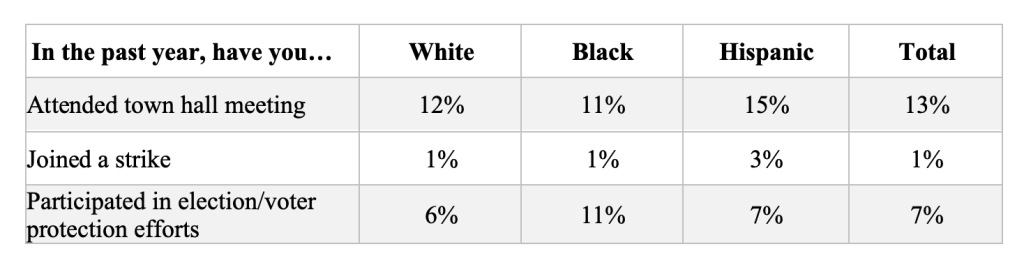
This year, we added questions about participating in election/voter protection efforts and joining a strike and find some interesting patterns of participation by race and ethnicity. In particular, Black respondents are much more likely to have participated in election/voter protection this year and Lationo/a respondents are more likely to have attended a town hall meeting and participated in a strike.
We are still just beginning to dig into this new dataset, so stay tuned for more findings! For anyone interested in understanding how Americans’ media diets have changed over the past year, check our our new report, which documents how young people have shifted to Fox and Republicans have shifted to CNN this year.

