
(and what’s missing from the pro-democracy movement)
This week, Arman Azedi and I published a research brief about civic participation and protest in America. In the piece, we analyze data that were collected from over 23,000 Americans in spring 2026 as part of the Democracy for All project. The dataset is a treasure trove of information about how Americans participate in and view democracy in America today. Among many other topics, it provides valuable insights into who is protesting in America right now and how the movement to protect democracy might expand during this crucial time.
Overall, the data show that protesting in America is up: 16% of Americans in the Kettering-Gallup survey reported participating in protest, and an additional 28% reported wanting to participate. These statistics on protest participation are even higher than levels observed during the first Trump Administration, which was considered a high point in civic participation and protest in America. Back in 2018, a Washington Post-Kaiser Family Foundation poll found that 12% of American adults had participated in a protest since the beginning of the first Trump Administration.
One of the most startling findings in our analysis is how the Democracy for All data, which were collected from the general population, compare to the data we have collected from the largest mobilizations in the US during the second Trump administration. Collecting survey data from random samples of protest participants during the biggest days-of-action to protect democracy and protest the actions of the Trump Administration, we have found that protesters tend to be highly educated, left-leaning, predominantly White, and older. In other words, Resistance 2.0 looks a lot like the Resistance that mobilized to protest the first Trump Administration).
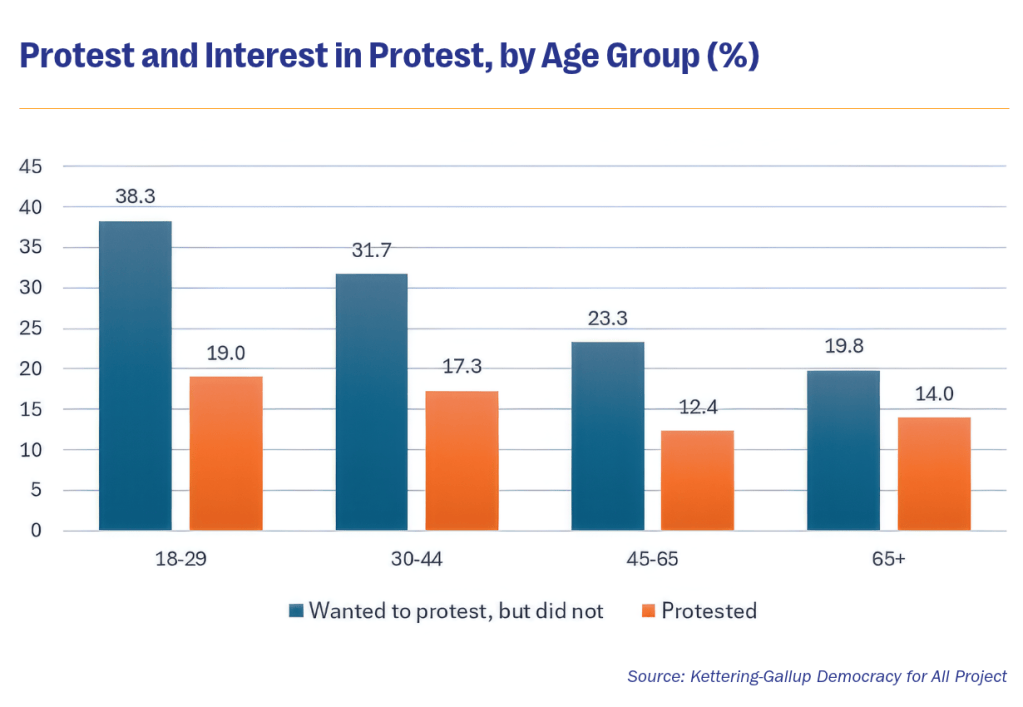
The Democracy for All data also show that protest participants in America today tend to be highly educated and left-leaning. In contrast to our findings from surveying activists at these large-scale days of action, however, the national data show that young people aged 18–29 were most likely to report participating in protests over the past year. In other words, young people are protesting, but they are not channeling their activism into the major mobilizations of the current pro-democracy movement.
As civic and political groups work to safeguard our election and protect our democracy, they will need to figure out how to tap into this important demographic. A recent study noted that young Americans are disillusioned with democracy and experience deeper economic insecurity than their elders. It is not entirely surprising then that younger Americans are not showing up to defend a system that they feel never worked for them. Instead, they are likely more interested in deeper, structural change, rather than preserving existing institutions and systems.
The data my team has collected from protest participants since January 2025 shows how younger Americans tend to prioritize other issues, such as opposition to the war in Gaza and racial justice. Thus, one strategy for channeling more young people into the pro-democracy movement involves connecting pro-democracy sentiment with efforts toward more robust socioeconomic and political changes in America.

