
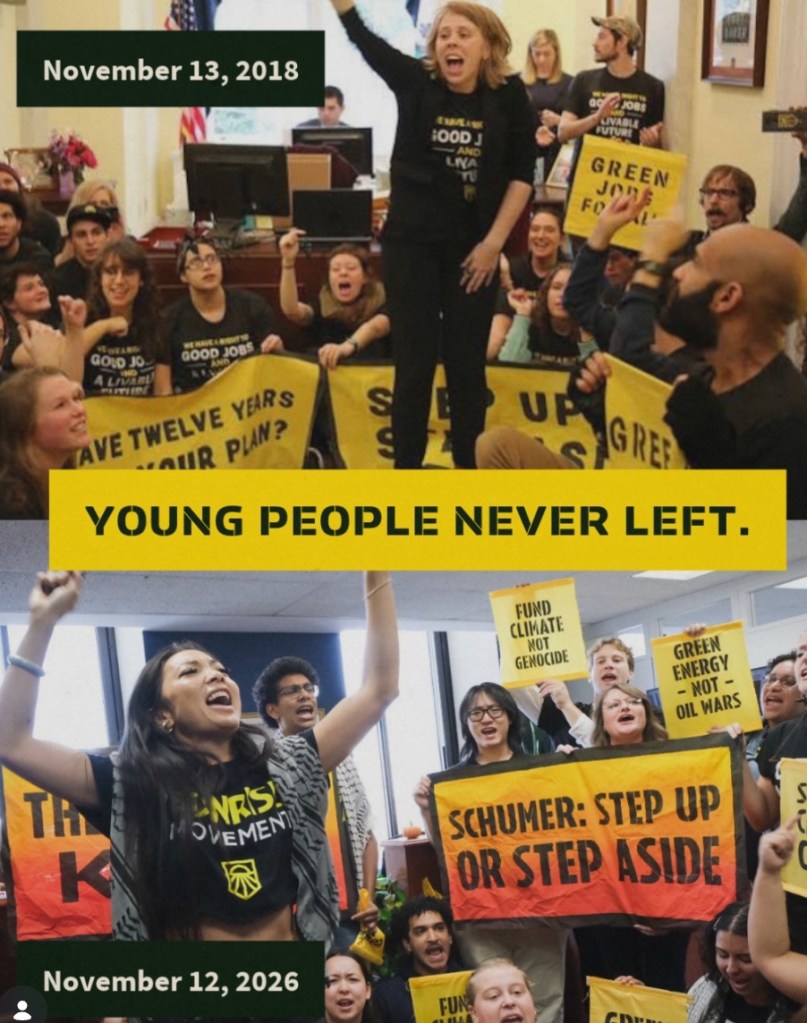
This Thursday (November 12th), young activists from Sunrise Movement staged a sit-in in Chuck Schumer’s office in Washington, DC. The occupation of the Senate minority leader’s office came almost exactly 8 years after Sunrise drew national attention for occupying Nancy Peloisi’s office with newly elected representative Alexandria Ocasio-Cortez.
That first protest in 2018 took place the week after a Blue Wave had swept the House of Representatives during the first Trump Administration. In the eight years since, much has changed: autocracy has spread across the US (and many other industrialized nations), the repression of peaceful protesters has grown, and the climate crisis has gotten much worse.
My new paper, “Whither the Climate Movement (and What Comes Next)?, discusses how the climate movement has changed since this time when school strikes and youth led demonstrations motivated millions to turn out and call for climate action around the world. The paper describes how the growing repression of peaceful climate activists and the demobilization caused by the COVID pandemic led the movement to enter a state of abeyance. Abeyance refers to ‘a holding process by which movements sustain themselves in nonreceptive political environments and provide continuity from one stage of mobilization to another.’
One sign that the climate movement is in abeyance is the degree to which climate groups have refocused their efforts to address other social problems. Sunrise, for example, currently lists four active campaigns on its website and only one is directly focused on climate change: ICE out for good, Schools drop ICE, Electoral Organizing, and Green New Deal for Communities.
Now that we see young people occupying congressional offices again, we might be inclined to believe that the climate movement is back. But, it’s really too soon to say. Even with the overwhelming wins by Democrats in the mid-term election last week, which will create some level of political opportunity at the Congressional level, the Trump Administration will continue to block clean energy expansion, support the growth of fossil fuel infrastructure, drill, and repress.
As I explain in the new paper, it is highly likely that we will not see a broad and invigorated climate movement until personal grievances spread: “When enough people experience the effects of the climate crisis firsthand, we will see a resurgent challenge from climate-focused activists.”

