How Inequality Mediates our Recovery from Climate Shocks
A lot of my recent research has been focused on understanding how climate shocks motivate social change, and the ways that process works in reality.
To that end, I have studied the effects of the Palisades and Eaton fires that struck LA County in January 2025. Julie Gonzalez and I wrote about how the effects of disasters like the LA fires are not experienced equally for all: “Latino, non-White, and non-English-speaking populations fac[e] higher risk of exposure and lower likelihood of recovery.”
I spent last week in Los Angeles doing research for my Workforce Development and the 4Rs project, which documents how volunteer and service corps programs are supporting disaster response and recovery across the US. As part of the project, my team and I spent time with folks from the Palisades Recovery Coalition and the Eaton Fire Collaborative in Altadena.
During these visits we learned how survivors from both fires have been facing challenges with insurance companies as they work to recover. We also heard specifically about how the residents of Altadena, who have less resources on average than those in Pacific Palisades, have struggled as their fire dislocation coverage has run out.
Most insurance companies cover ‘additional living costs’ for 12-24 months after a fire. At 18 months after the wildfires, many residents have lost this support. In other words, homeowner’s insurance is no longer covering temporary housing while recovery continues. If you drive through Altadena, you will see people living in vans an other temporary structures on the sites where their houses once stood. When I visited the Pacific Palisades, in contrast, I did not see any temporary structures.
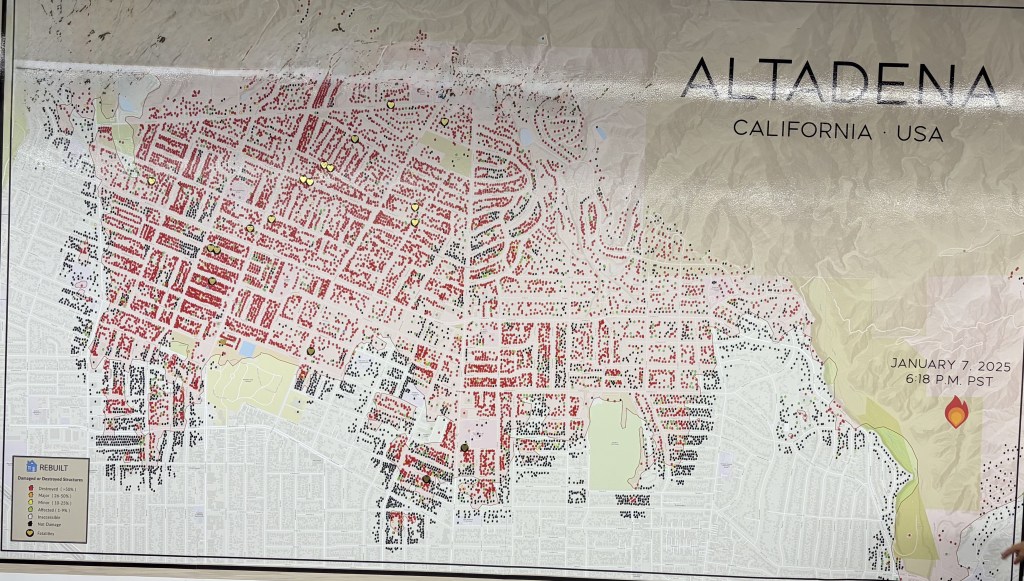
The map above hangs on the wall by the entrance of the Eaton Fire Collaborative and gives a sense of how big the need is for long term support. It maps all of the houses affected by the fire along with community progress towards recovery: all of the red houses were destroyed and, if you zoom in, you can see the small number of blue houses that have been placed over the homes to indicate those that have been rebuilt (the gold stars indicate sites where people loss their lives in the fire). To date, only a handful of blue homes have been put on the map and full recovery is estimated to take 8 years.
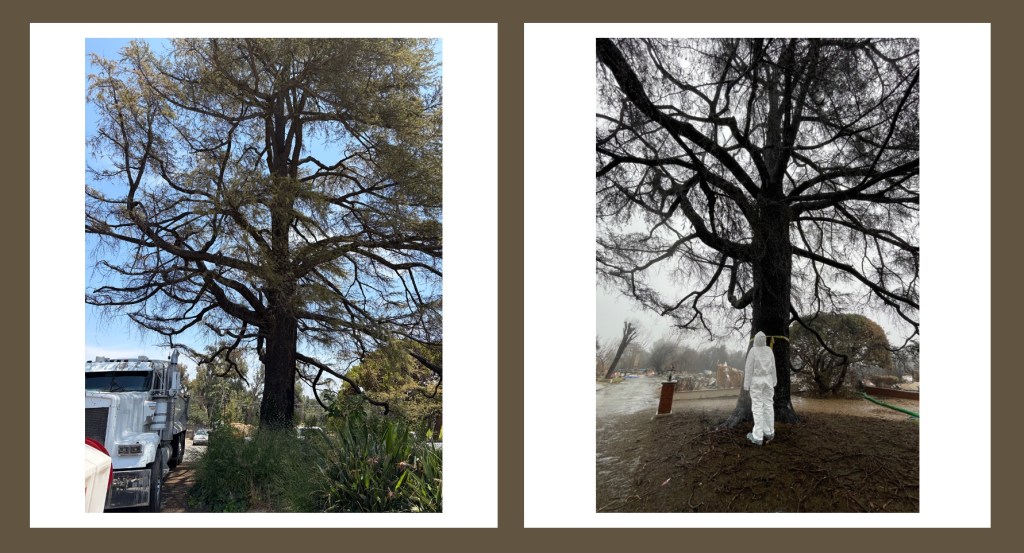
I’ve been to Altadena three times since the wildfire burned through the area. Each time, I visit the same neighborhood. Below is an image from last week next to the same spot in February 2025. I am heartened to see that construction crews were on site and they are starting to clear out the debris to rebuild. There’s no question, though, that the neighborhood and the community still have a very long road ahead to recovery.