
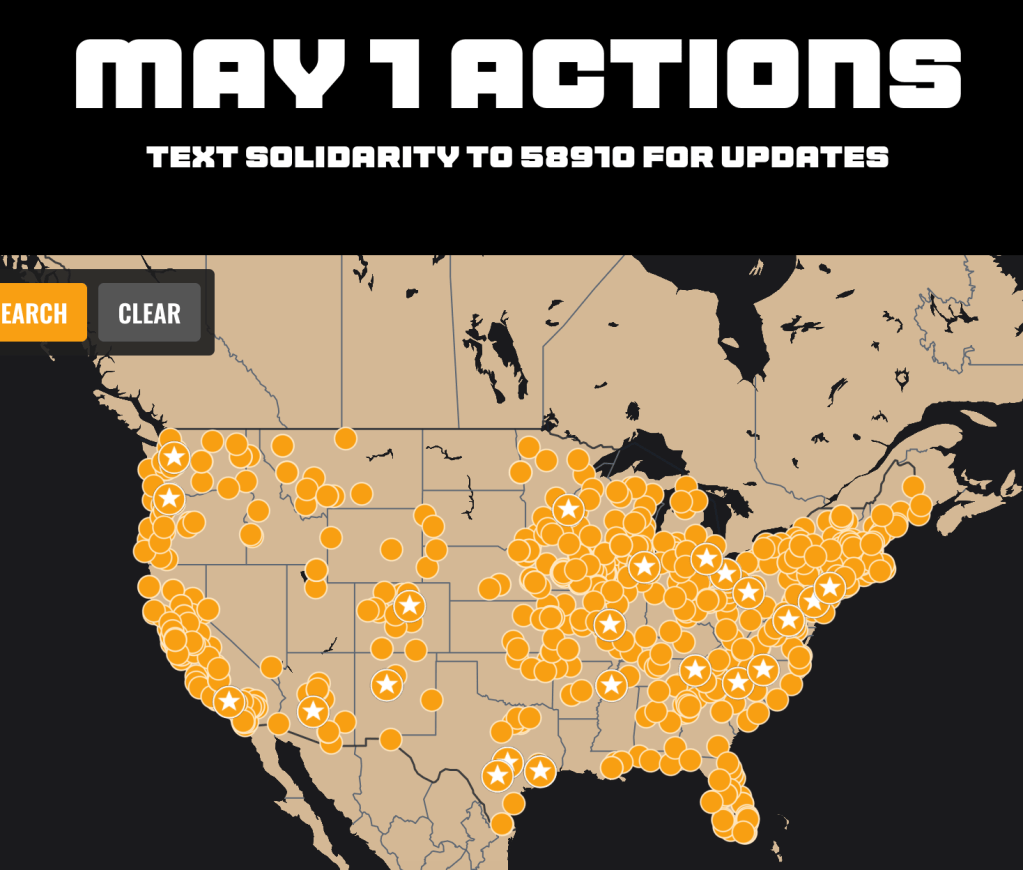
This coming Friday, the May Day Strong coalition (which includes over two hundred progressive groups and unions) is calling for “workers, students, and families [to] rally, march, and take action across the country to demand a nation that puts workers over billionaires, with many refusing business as usual through No School. No Work. No Shopping.”
Before May Day, it’s worth revisiting how strikes build power. This article on the history of general strikes in the US provides a good overview:
“A general strike encompasses workers from a broad range of occupations and shuts down the delivery of all private and public goods and services in an area, such as a city or state. They usually occur at a time of heightened economic tension, when employers are demanding big concessions from labor, or even trying to destroy unions. Sometimes a defensive struggle of one union can spread as other unions — as well as non-union workers, students, and the broader community — join the fray to express solidarity and broaden the demands of the struggle to include their issues.”
Although the May Day Strong coalition includes a number of unions, it’s unclear what actions workers are preparing to take collectively (if any) on May 1st. Historically, it is this type of collective action that is central to a general strike. But effective actions takes time and substantial coordination to organize, especially in the US, where workers who strike risk losing their jobs and substantial backlash.
It is much more likely that the majority of the actions we will see on May Day will be solidarity strikes–including Resisters who commit to avoid economic activities for the day or students who walk out of school.
The May Day Strong coalition includes a broad range of Resistance groups that have been involved in coordinating large-scale days-of-action including the 3 No Kings Days. These actions have mobilized millions of Americans to participate in non-violent demonstrations and rallies on Saturdays. As my research has documented, these days of action have mobilized crowds that are majority female, predominantly white, highly educated, middle-aged, and overwhelmingly voted for Harris in the 2024 election.
In contrast to collective efforts to strike at specific workplaces, it will be much harder for more distributed commitments to be visible at the national level. In his column about May Day this week, Will Bunch asks the billion dollar question: “How many people would need to stop shopping to make a noticeable dent in the nearly $3 billion per day Americans spend?”
Even if May Day Strong does not stop the economic workings of the US for the day and is not clearly noticeable to everyone, these events can still build power. With over 1,300 events scheduled to take place across the US on Friday, May Day Strong has the potential to expand the Resistance toolbox by exposing people across the US to a wider range of civic tactics that we can all use to channel our power and push back to autocracy.

