
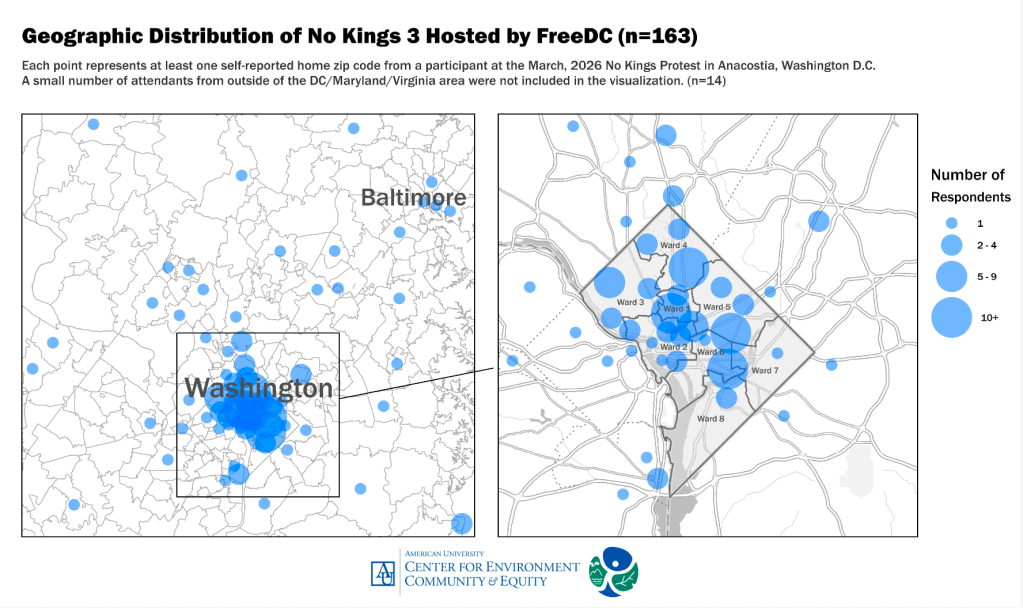
There’s been a lot of discussion about the ways that the Resistance to the 2nd Trump Administration (or Resistance 2.0) has been leaning into a more distributed model of protest. Although No Kings 3 last weekend included some very large crowds, including the Flagship Rally at the Minnesota State Capitol that included Bruce Springsteen, Tom Morello, Bernie Sanders, Jane Fonda, and many more high profile speakers, the majority of the 3300 events on March 28th were local. Around my house right outside the District of Columbia, a local groups occupied overpasses and coordinated protests at intersections.
These events were peopled by members of the community and organized by local groups. In Washington, DC, for example, there were four events planned inside the District of Columbia. My team and I collected data at the event that was coordinated by FreeDC and cosponsored by a number of unions (read about some of our preliminary findings here). Our team collected data as people assembled to rally and march over the Frederick Douglass Bridge in Washington, DC.
In the visualization of the event’s turnout above, which is based on the data we collected from participants, we can clearly see that participation was predominantly local: approximately 85% of respondents reported a home zip code within the District of Columbia, 13% of those respondents were from Ward 8 (where the protest took place) or an adjacent Ward, and only 9% of participants reported coming to the event from outside the local DMV area.
Not only was the event peopled by locals, but many of the people who participated were connected to groups helping to coordinate the event. Almost half of participants at the event (47%) reported being a member of a group that was organizing the event and 27% of participants reported being members of the local organizer, FreeDC. Moreover, most of the people who turned out for this event reported hearing about it from friends and family members (38%) or directly from organizations (34%). This percentage is much higher than the 13% who reported learning about the first Women’s March in 2017 from an organization.
Although locally embedded groups and distributed days of action tend to turn out less visually dramatic crowds, the value of personal and organizational social ties is clear. People who are more socially embedded are less lonely and tend to have a stronger sense of their personal political power. Moreover, social movements and political campaigns that are locally embedded have been proven to have the strength and durability to persevere through difficult times and sustain their struggles so that they can achieve their goals.
 Dana R Fisher