
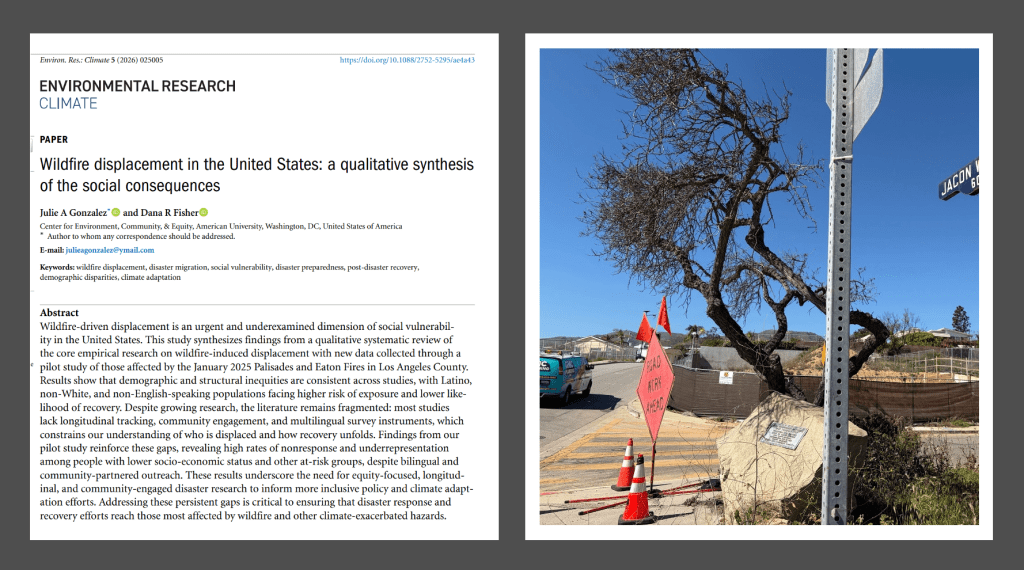
This week, my paper on wildfire displacement (co-authored with Julie Gonzalez) was published at Environmental Research Climate. The paper summarizes our efforts to understand the social consequences of wildfires after the LA Wildfires in January 2025. Our goal was to study the ways that people personally and collectively experience the effects of wildfire and what comes next.
As we reviewed the existing research on the subject, though, it became clear that there were a lot of blindspots in the literature: there was limited tracking of those affected over time, even less of an understanding of community engagement, and survey instruments that were used to collect data were almost exclusively offered in English. Our hope was that by fielding a survey in the two most common languages of the areas affected–English and Spanish–and doing our outreach through community groups, we would learn a lot more about the social consequences of these wildfires.
Unfortunately, the data we collected were very limited, so we were unable to answer many of the research questions we asked. The people who did participate in our pilot study were much more economically secure and highly educated, and less racially and ethnically diverse than the populations that had been living in the areas hit by the fires. Moreover, only 8% of respondents completed our survey in Spanish despite the fact that Latino residents made up 23% of the population across all wildfire evacuation zones in the area.
In addition to these findings, we also found that there were very high rates of nonresponse for all core demographic questions in our survey. Because of the significant missing data, we were unable to assess the extent of inequity across the sites and interpret the experiences for those affected by the wildfires with any certainty.
We conclude the paper by discussing the importance of the missing data:
“The gaps [in data] are not simply methodological shortcomings or artifacts of survey design. These results are consistent with prior research indicating that disaster-affected, socially vulnerable groups are less likely to participate in surveys or complete demographic questions, often due to mistrust, survey fatigue, or privacy concerns.”
In short, to understand the real world social effects of climate shocks like the LA Wildfires, we must work harder to make sure everyone is represented in our research. To address these issues, I am working on a new project that aims to address this very issue by working more directly with civic groups in communities and developing tools to track those affected long term. Figuring out an effective way to collect data post disaster is all the more important as the federal government substantially reduces its efforts to collect and share much of the social and environmental data that researchers have used to make sense of the world.
 Dana R Fisher