
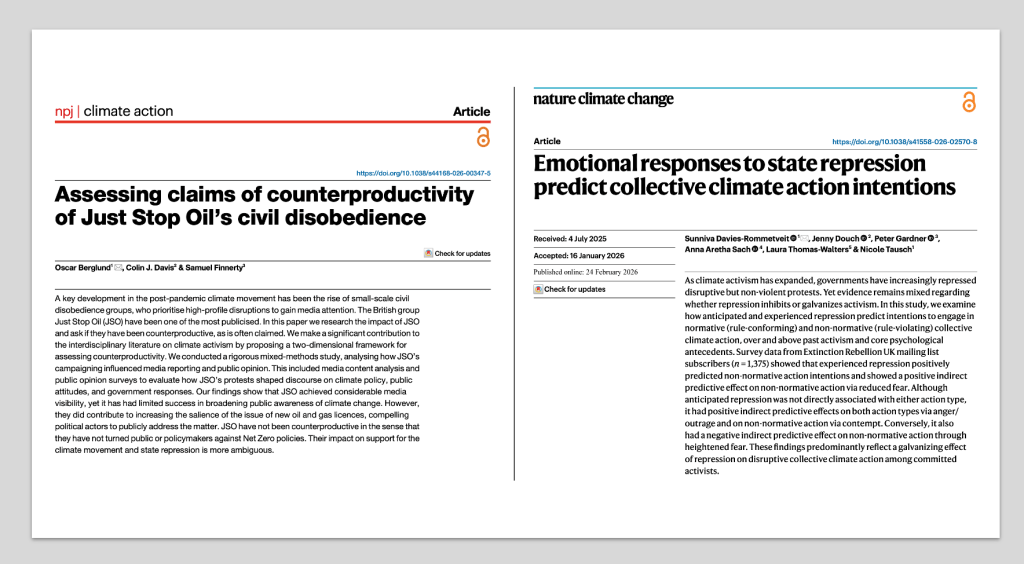
I write a lot about protest and the ways that repression can escalate violence and lead to more disruptive tactics. So, I was delighted to read these recently published papers that help us understand more about the effects of state repression and civil disobedience.
First, a team of scholars (including some of whom are members of Scientists for Extinction Rebellion) took advantage of their access to the group to study the relationship between state repression and the intentions of activists. The authors find that anticipating repression had no effect on collective action (which is particularly interesting given that climate activists in the UK face some of the most severe state repression). This research on members of Extinction Rebellion in the UK documents how experiencing repression is statistically significantly associated with intentions to engage in what the authors call non-normative forms of collective action, which they measure through willingness to engage in seven types of actions: “a sit-in or lock-on, block streets or public buildings, take action to disrupt major polluters, occupy a threatened natural space, an action involving property damage, an action that is likely to result in arrest, an action that is likely to result in arrest with serious jail time.” In other words, experiencing repression did not discourage activists from collective action. Rather, it radicalized them. Read the whole paper here.
Second, a different team of scholars (two of whom I’ve published with in Nature), do a deep-dive into the effectiveness of civil disobedience. The authors integrate data from a range of sources to conduct their research, looking at media coverage, public opinion, and data on actual oil and gas licenses to understand the impact of the group Just Stop Oil and their civil disobedience in the UK. This type of a mixed methodological approach, looking specifically at the relationship among media attention, public opinion, and policymaking is great to see! Too often, scholars use online simulations that they then assume to be generalizable to the real world (which it frequently is NOT). The authors conclude that the organization’s acts of civil disobedience “succeeded in getting media attention, contributed to raising the salience of oil and gas licences in the North Sea, and politicising the issue.” The effects of these acts of civil disobedience did not have an effect on public opinion about climate change or oil and gas licenses–ie they were neither effective nor counterproductive. Read the whole paper here.
 Dana R Fisher