
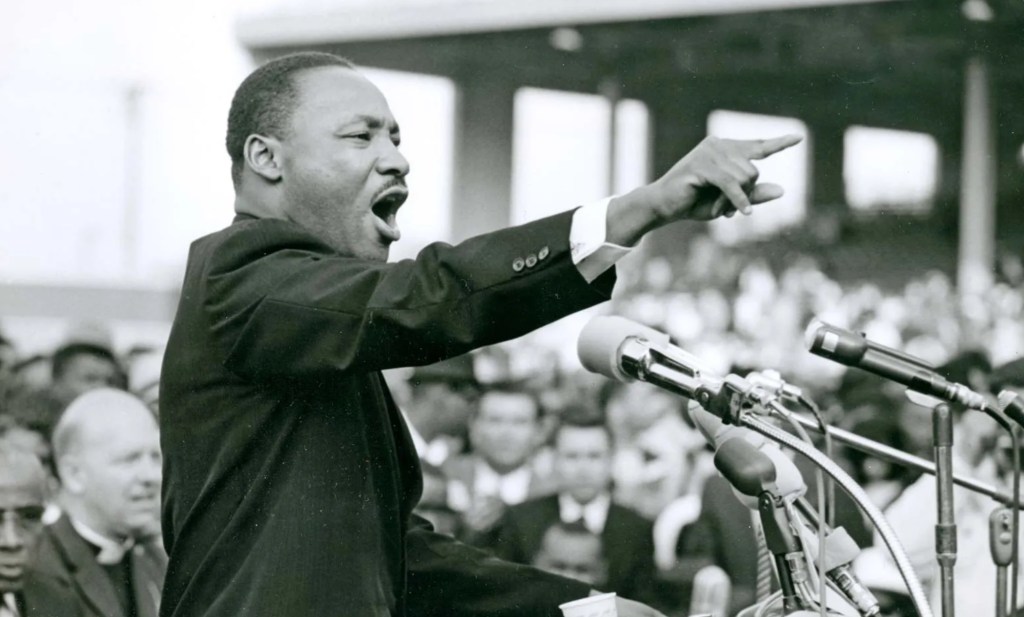
Lessons from MLK that can help guide us in these precarious times:
In honor of Dr. King, I want to talk today about one of his lesser known speeches: a commencement address he delivered at Oberlin College in June 1965 (so over 60 years ago). The title of the address is “Remaining Awake Through a Great Revolution.” In it he says:
“There is nothing more tragic than to sleep through a revolution. There can be no gainsaying of the fact that a great revolution is taking place in our world today. It is a social revolution, sweeping away the old order of colonialism. And in our own nation it is sweeping away the old order of slavery and racial segregation…The great challenge facing every individual graduating today is to remain awake through this social revolution.”
At the time of the address, Dr King was reflecting on the ways that freedom and human dignity were what he called “the idea whose time has come.”
In 2026, we are living through a very different time. I wonder what Dr. King would say about the social revolution sweeping over our country today? If he could observe America in 2026 and witness the spread of Racism, Xenophobia, Antisemitism, and Intolerance that have taken hold of much of our country, what would Dr. King say about the people who are sleeping through this revolution?
I’m an Apocalyptic Optimist. That means that I find hope in our growing despair and that I believe that things are going to get worse before they get better. My brand of apocalyptic optimism means that I believe that the only way to get us where we need to go is by being realistic about the state of the world (and the state of our country). Unless we get realistic about the path we are on, too many of us will be caught off guard. This point is particularly important since it’s becoming increasingly clear that not paying attention to reality opens people up to misinformation and conspiracy theories that are distorting reality for many Americans.
When I was originally asked to speak, I had planned to talk today about the legacy of Dr. King and how his legacy can inspire us to build solidarity during the polycrisis that we’re living through, which includes the demise of our democracy along with the climate crisis. But that was before Renee Macklin Good was shot and killed by an ICE agent on January 7th while she was protesting peacefully in her community. She and her wife had been participating with community members in a type of protest that some are calling “First Amendment protected taunting”: they were leveraging their privilege as White Women and American citizens and getting in the way of ICE agents in Minneapolis, asking them questions intentionally to distract them while filming the interactions on their phones.
Since the shooting, we have seen a wave of activism: Last weekend, more than 1,000 events took place across the US to protest the Trump administration’s immigration enforcement tactics; protests have continued throughout this week and are likely to expand as violence inflicted by ICE has been publicized (including more shootings); next Tuesday, people in all 50 states will participate in the nationwide Free America Walkout; and Minnesota unions have called for a mass work stoppage next Friday.
While there’s no doubt that Dr. King would be horrified to see what the US has become, there’s also no question that he would be delighted and inspired to see people pushing back with a range of nonviolent tactics. In fact, he’d certainly be marching in the streets and joining the walkouts and strikes with everyone else.
Right now, too many of us are trying to figure out how best to raise our voices against this growing autocracy—how do we face conspiracy theories and misinformation with reality? When people driving on their way to work or to the hospital are not safe from attack and peaceful activists are threatened, what do we do and how do we respond? What are the most effective ways to push back against the Trump Administration and how can we personally make a difference in this struggle?
I’ve studied countless social movements, and my research finds time and again that the most effective and durable ones are those that bring together people with diverse identities and orientations.
What we are seeing today reminds me of the activism that took place across the US in summer 2020.
After George Floyd was murdered that May, we saw the largest sustained period of activism in US history (and the protests were overwhelmingly peaceful). My research has documented how people of all identities and orientations turned out to protest TOGETHER and call for racial justice at all levels of governance. The mobilization integrated intersectional calls for racial equity, womens’ rights, immigration rights, and LGBTQ+ rights at the same time.
One of the most important aspects of the movement in the summer of 2020 was the solidarity we saw in the crowd: in contrast to the activism during the Civil Rights Movement, which was mostly peopled by Black Americans. Summer of 2020 turned out diverse crowds of activists across the US to protest systemic racism in America: Latino participants joined because they were worried about immigration policies, LGTBQ folks participated because they were also concerned about LGTBQ+ rights, and women reported joining because they were worried about Women’s Rights and Reproductive rights under the first Trump Administration.
Rather than dilute the message, so many people working across identities, orientations, and social classes amplified the call for action.
In many ways, the behavior of federal agents in Minneappolis are increasingly resembling the ways that law enforcement and countermovements treated Black Americans during the Civil Rights Movement. The movement pushed back together with dignity and nonviolence. Dr. King and the civil rights movement were extremely unpopular and many faced death threats and jail time but nevertheless they persisted.
Our answer today must involve mutual understanding and collaboration.
In other words, it’s time for us all to stop building silos and start building solidarity that supports and amplifies.
To that end, I challenge everyone in the room to think about how you personally can extend your engagement and activism beyond your silos and build resilient roots and connections where you live and work. We need to build true solidarity and networks of support that connect individuals inside and across communities.
I can’t tell you what is going to come next. What I can tell you is that it’s going to take every one of us doing anything and everything, including actions for justice and equity that may take us out of our normal comfort zone and stretch us in ways that help preserve democracy.
As Dr. King said in that same speech (I have updated the language so it is more inclusive across genders):
“Through our scientific and technological genius, we have made of this world a neighborhood and yet we have not had the ethical commitment to make of it a
brotherhood[family]. But somehow, and in some way, we have got to do this. We must all learn to live together asbrothers[family] or we will all perish together as fools. We are tied together in the single garment of destiny, caught in an inescapable network of mutuality…This is the way God’s universe is made; this is the way it is structured.”
I interpret these wise words from a very different moment in our country’s history in this way:
We don’t need a hero; we need a movement that unites us all in our common struggle and lifts us up together. Everyone has a role to play and the potential to be leaders and bridgebuilders as part of this movement we so desperately need.
As unfair as it may seem, no one is coming to save us: we must remain awake through this social revolution. In fact, it’s not enough just to be awake: We have to be engaged and connected to one another so we can work together to transform this retrenchment into democratic progress. We’re all going to need to work together to Save Ourselves.
 Dana R Fisher