
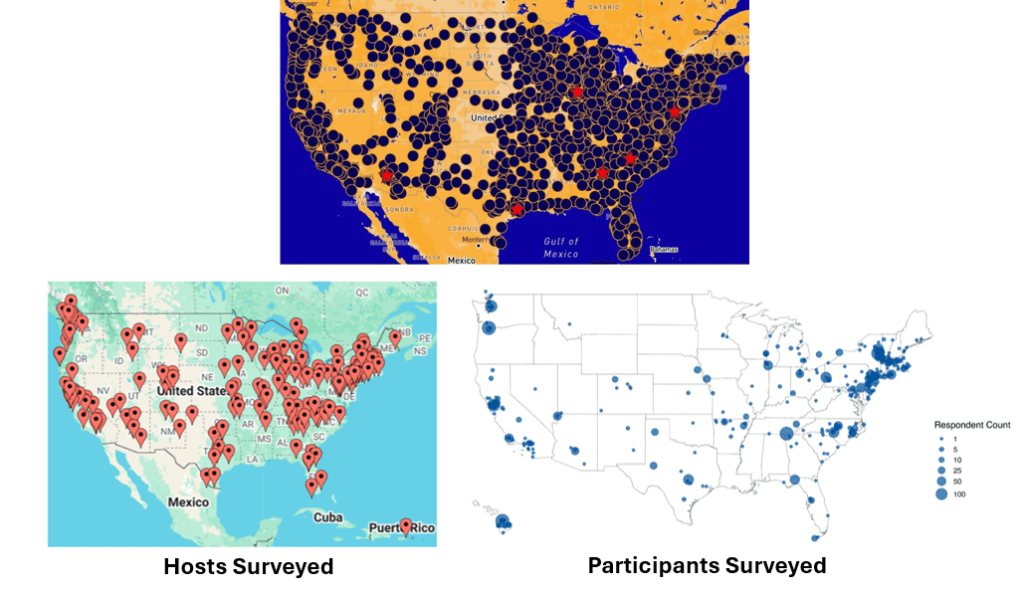
One of the challenges of studying protest in this era of distributed activism is that it’s extremely difficult to get a decent sample of who is participating across sites. When my team surveys at a large-scale protest event, like the Women’s March in Washington, DC in January 2017, we are only able to generalize our findings to the specific location where we sampled participants. In an effort to get a sense of the #NoKings Day-of-Action across the US, we worked with the organizers of the event to survey hosts coordinating these distributed actions. We then asked the hosts who participated in the study if they would share a link to our anonymous survey with the participants who signed up for their specific events.
It’s an imperfect procedure and not the same as a random sample, which we collect when we survey in the streets (as we did at the flagship protest in Philadelphia on No Kings Day). However, through this process, we were able to collect data from 207 hosts and participants from 304 of the events that took place across the US on No Kings Day (see the maps above for the geographical distribution of respondents in each sample vs the distribution of events nationwide during the Day-of-Action). These samples represent a small fraction of the participants and events that took place during this incredible day of protest. Nonetheless, they tell us more about who participated nation-wide. Here are some of the most notable findings across the samples of hosts, national participants, and participants at the flagship protest in Philadelphia.
Participants were highly civically engaged and overwhelmingly supported Harris in the 2024 election (98% of hosts, 98% nationally, and 97% in Philadelphia).
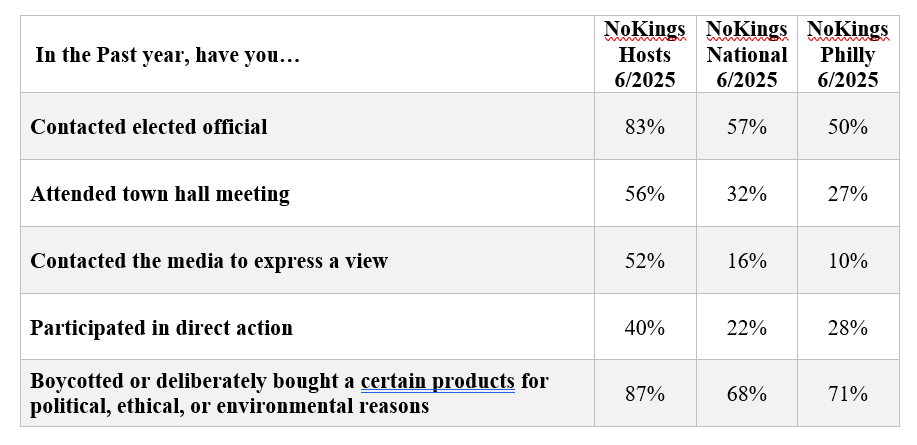
Even though most participants reported not having participated in civil disobedience/direct action in the past year, over 93% of hosts, national participants, and participants in Philadelphia reported supporting groups that employ non-violent civil disobedience as a tactic.
Indivisible played a significant role in organizing the event. Consequently, 70% of hosts, 41% of national participants, and 10% of participants in Philadelphia reported being members of the group.
Top motivations for participants across all samples were Trump and Immigration. Here are the other most common motivations across the samples:

When we look at the demographics of Resistance2.0 there is overwhelming consistency (and similarity with Resistance1.0): participants are predominantly White, highly-educated, female, and middle-aged.
 Dana R Fisher
One response to “What We Learned Studying the #NoKings Day Across the US”
[…] Fisher of American University and a team of researchers surveyed participants at more than 300 “No Kings” events last summer and found them to be predominantly […]
LikeLike